
Gratuitous

There are a lot of people seeing red these days. Apart from the ugliness in the news, I seem to be allergic to my house—either that, or my frustration with politics is literally beginning to change my eye color. It’s not a fun situation, and it may require me to move yet again if it doesn’t improve.

And yet, this week I scrubbed mold off the back deck.

I raked leaves off the driveway.

I bought a mum for the front porch.

I finally invested in a fine art print for the living room wall.

A few weeks ago, I planted bulbs in the back yard.

Why? If I might not get to stay, aren’t these expenses silly, if not downright wasteful? Moving is expensive, and this summer’s resentfully tall tomatoes were the last plants I intend to stuff in the backseat of my car.

I took that spartan approach for several weeks, but I was pretty miserable, and not just because of my inability to breathe normally.

My breakthrough moment came from a book called Culture Care, by an artist named Makoto Fujimura. He writes that a healthy culture needs things that are inherently gratuitous. I typically use that word only in reference to my own futile (and, let’s be honest, often accidental) layouts on the Ultimate field. Fujimura uses the word gratuity “to speak of intentionality, and even forcefulness” (28) —OK, that part sorta fits— “not necessary to our daily survival” (51)—yup, counter to it, in fact— that “points beyond itself, beyond survival to satisfaction” (52). Hmm.

Beauty, he says, “is expansive, generous, abundant, connected, and expressive.”

(Fine. My layouts are not.)

The point is, I’ve realized that I need the gratuitousness of small, beautiful, impractical things in my life. They may not stop my eyes from itching, keep me from laying out for a disc I have no chance of catching, or prevent me from seeing red when I turn on the news, but they certainly alleviate the blues.

Two-lane Roads Diverged

Driving through Virginia this week, I’m pretty sure I discovered why so many rural Americans voted for President Trump: it’s because they have had to follow two slow-as vehicles on a two-lane road.

One you can handle. Two just make you long for anarchy. Everything feels stagnant, and any kind of change would be welcome.

In that realization, an entire language unraveled before my eyes.

  • “Political correctness” really means the second car out in front, but for whom you would be able to pass the dually with a good burst of speed.
  • “Snowflakes” are really the flimsy tires on your mid-sized sedan, which would pop if you tried to off-road.
  • “The right-wing news media” is the tricksy curve in the road that makes it impossible to pass safely.
  • “Illegal immigration” is the way the wide hubs of a dually truck overlap the left lane and keep you from seeing when it’s safe to pass.

It all makes sense now.

When I hit the highway again, I realized that passing lanes can give you a whole new hope for America.

The threat of dead house plant

Geronimo is a big, beautiful, waxy green spathiphyllum* who is 3.5 feet tall and at least that wide. After some initial hesitation at his sheer size, I have grown to appreciate his presence in my tiny apartment. These plants are known to be easy care, long living, and helpful in purifying the air.
The problem is, I am not good at keeping things alive, and when Geronimo dies, there will be a lot of dead house plant draped over my living room.

That’s one reason I avoid owning plants. Or being angry.

(Was that transition too abrupt? I’ve been told I do that sometimes. Don’t be mad.)

Recently, I was telling a story about something predictable yet frustrating. It was the kind of story that ends when you snort and roll your eyes and shake your head. It usually ends with, “Go figure. Moving on.”

But twenty minutes later, I was pacing around my apartment, restless, still thinking about it. It took me another twenty minutes of pacing to realize that I was angry.

Huh.

I held up the emotion and just studied it, like a creature I hadn’t seen in a long time–like a big gnarly house plant with glitter on its leaves. My thoughts, in order:

“That’s interesting.”

“This is weird.”

“I hate glitter.”

“What now?”

Anger is not unlike Geronimo, the way I see it. Anger may be popular, normal, even healthy in the average American life, but you eventually have to figure out what to do with it when it gets too big or starts to smell.

My typically solution is to avoid admitting anger, but that means I miss out on the healthy role it plays in clearing the air.

That was two weeks ago.

Today, I’m getting used to having a plant in the house. I’m aware of it, but it doesn’t get in the way as much as I thought it might. I keep an eye out for rotting leaves, and I might have to prune it back at some point, but it adds a pop of color to an otherwise sparse decorating scheme.

And I’m glad to have a bit of anger in my life now and then. It doesn’t get in the way as much as I think it will. I keep an eye out for self-destructive anger, and I might have to apologize for it now and then, but it keeps me honest, and I’m definitely glad it’s less than 3.5 feet tall.

Geronimo, just stay away from the glitter, and I think we’ll be fine.

The end.

*And yes, I recognize the irony of personifying anger as a peace lily.

Dear Me

Dear ten-year-old version of myself,

Today I ate an entire yellow bell pepper for lunch because I’m an adult, and I can do what I want. There are some real advantages to this growing up business.

Don’t get me wrong, the dire stories you hear about responsibility and paying bills and doing taxes are real. They are not fun.

But a big piece of adulthood is the freedom to arrange your life in a way that makes sense. In a way that is meaningful. In a way that includes ice cream for breakfast and a terrible stomachache by 10 a.m. that you and you alone are responsible for.

It’s worth it.

In the meantime, we’ve GOT to talk about that haircut…

Love,

J.

Turning End Tables

There was a new bruise on my knee this morning, roughly the size and shape of the coin slot in a pool table.

This time I know where it originated (excitement over a particularly close shot in last night’s UNC – Oregon game while standing unfortunately close to the aforementioned pool table), but that’s not always the case.

I tend to move through life at high speed, whether it’s Ultimate Frisbee, swing dancing, speed walking to get out of the cold, or power walking to assert a confidence I don’t feel. Unfortunately, when you combine that tendency with inherent clumsiness and legs that stretched me from 5′ 4″ tall in ninth grade to 5′ 10″ by eleventh grade, you get a lot of unexplained bruises. End tables, counter corners, TV stands, bed frames, and trailer hitches just aren’t my forte.

More recently, I’m finding that when it comes to bruising, end tables have nothing on the sharp corners of my assumptions.

Allow me to explain.

If you know me, you know how I relish a good pun or a witty repartee. At high speed, it’s lighthearted, a little sloppy, a little lazy, but it feels as good as sprinting past an opponent on the sports field. This year has provided numerous opportunities for that kind of banter. I think you know what I mean.

Then comes the crash.

It might be a direct comment that cuts the motion short. It might be more subtle–a too-slow laugh or an abrupt departure. Those breath-catching, eye-watering corners of the metaphorical end table let me know that not everyone present is of the same mind, as I had assumed. Sometimes I know exactly when and where it happens. Sometimes I don’t realize it until the next week, when a bruise blossoms in a friendship. Those deep tissue bruises are the worst.

Does that mean I’m stepping back from the banter or the snark? Not a chance. (Don’t get your hopes up, my non-pun-loving friends. I’m not ready to pun…t.) Rather, I’m just trying to develop a little better spatial awareness.

Note to self: Before having a verbal dance party, be sure to push all assumptions to the edges of the room.

Your shins, and your companions, will thank you for it.

Now if you’ll excuse me, I need to go rearrange some furniture.

Copyright and Copywrong

“It’s on the Internet, so it must be okay to use it.”

Nooooooooooooooooo. As a long-time writer and blogger who currently works in the publishing industry, this has to be one of the most cringe-worthy statements I hear from fellow bloggers.

And although most lawyers may be snarks, not all snarks are lawyers, so please be aware that nothing in this post should be construed as legal advice. Also note that this post is also going to have more exceptions and disclaimers than a college student’s class presentation.

That being said, there are a lot of ways to copywrong, but there are also some rules of thumb that will help us all be more ethical on the Internet.

<soapbox>


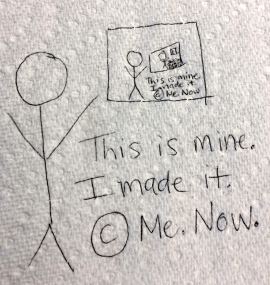
myart1Mom was right: your drawings are the best.

I know the Internet has made it easier than ever to use a variation of right click + save as to make someone else’s image your own, but in this case, right click is usually the wrong click. Stick to your own photographs and illustrations whenever possible, or invest in a subscription to a stock image site. Trust me: the Internet will love your stick figures.

The Internet is wrong sometimes *gasp.*

If you’ve found the perfect image, look for a page on the site called “Terms of Use,” “Copyright Information,” “Licensing,” or “Use Guidelines.” If the site doesn’t have one, it’s likely that they are not in the business of distributing images. Even if they assert that an image is in the public domain, they may be misinformed. Not everything on Wikimedia Commons is free and clear, and every search engine has a disclaimer passing the buck to the user for verifying copyright status.

Pre-1923 is the place to be.

Add this one to the likes of, “In 1692 Columbus sailed the ocean blue” and “Remember, remember the 5th of November.” For copyright, 1923 is the date to remember, because most works published in the United States before that date are in the public domain, meaning that the majority of copyright laws do not apply. (Disclaimer! Disclaimer!  Exception! Exception!)

Grandma Moses may seem like a sweet folk artist, but you don’t want to mess with her estate.

The word “published” is more vague than “mansplaining” when it comes to works of fine art, so tread carefully. BUT, if a 2D work of art is in the public domain, faithful replications such as photographs can’t be copyrighted either, so that simple photo of the Mona Lisa is probably safe. (Disclaimer! Exception!)

Take a hint from elephants: steer clear of the mouse.

Disney in particular is notorious for taking legal action to protect their trademarked characters, such as the princesses or Mickey Mouse. Sports teams are also invested in making sure that no one replicates their logos and mascots without paying licensing fees.

Remember the days of websites with autoplay, and channel that thought if you’re tempted to stray.

The copyright laws for musical works and sound recordings might be one of the strongest reasons we need librarians. So many different rights are involved that unless music is a central component of your creation, refrain from adding a soundtrack.


The bottom line is this: it’s your responsibility to educate yourself about the basics if you’re thinking about adding someone else’s materials to your creative work, whether text, image, audio, or video.

As a bonus, if you spend enough time slogging through the minutiae of copyright law, you’ll develop a practically unlimited font of snark to unleash upon the world. #originstory

You’re welcome.

</soapbox>

Resources

How do you solve a problem like millennials?

(It’s not quite the Von Trapps or Margery McKay, but it’ll do. #nerd)

maria-thumb1-540x362How do you solve a problem like millennials?
How do you catch their eye and sell them stuff?
How do you find a word that means millennial:
a narcissist man-child? a delicate flower? our pride?

Many a thing you know you’d like to tell them.
Many a thing they ought to understand!
But how do you make them stay
and fill out your last survey?
How do you keep them focused on a job?

Oh, how do you solve a problem like millennials?

How do you choose emojis for your ads?

When I’m with them I’m confused:
do they focus? are they rude?
and I never know exactly who they are.

–Just as timely as a lunch break,
they’re as fragile as a snowflake
–They’re the future!
–They’re our downfall!
–They’re the best!

–They’d out-Twitter any bird;
drive a hashtag as a #nerd.
–They could crash a social platform with a friend.

–They are driven; they are fine,
–They’re a riddle; they’re just Vine.
–They’re a headache!
–They’re all angels!

–They’re a trend!

How do you solve a problem like millennials?

How do you catch their eye and sell them stuff?
How do you find a word that means millennial:
a narcissist man-child? a delicate flower? our pride?

Many a thing you know you’d like to tell them.
Many a thing they ought to understand!
But how do you make them stay
and fill out your last survey?
How do you keep them focused on a job?

Oh, how do you solve a problem like millennials?
How do you put your craft beer in their hands?

The Wax in My Coffee

One day last week I was running late by the time I made it to the kitchen for my morning coffee. I was leading an early meeting, so I desperately needed caffeine. I reached automatically for the jar where I keep the beans. I shook it. It was the worst sound in the world–silence. There was no coffee to be had. I scrabbled frantically through the cupboards in search of a secret stash I had failed to stash.

That’s when I saw the centerpiece.

img_7076

I got it a few years ago in one of my artsy phases. I’ve burned a lot of candles in it, but it’s been sitting on top of the microwave for the last year, gathering dust.

I looked at it for long time. (That’s what I’m telling myself now. It wasn’t actually a long time.) I had already decided to overlook the dubious extras. That’s what filters are for: filtering…stuff. In my state of desperation, I convinced myself that any coffee would be better than the situation I was facing. Check.

But then, I was picking out wax bits, and there were weird textures mixed in with the coffee that I thought would go away once I put it in the press, but they didn’t, and it was definitely affecting the flavor. My confident, “Any coffee is better than no coffee” seemed more dubious by the minute..

And suddenly it was a political metaphor.

Ever since the presidential election in November, I’ve tried to preserve the ability to converse without ending up on the subject of politics. While I think good governance and active citizenship matter greatly, there’s a vast difference between deliberate conversation and flippant remarks or casual references. Plus, I just want to be able to talk about other things! Yet somehow, the most ordinary topics have veered back toward Washington.

For instance:

A squirrel was hanging from the roof of my balcony, dangling from the gutter in order to get to a birdseed wreath I had hung there. Even though the squirrel had access to a disproportionate percentage of the available food, it clung to a desire for more, causing a massive flock of birds to descend on the balcony and tweet their displeasure.

See what I mean?

I have a real problem.

It’s as though politics has become the “That’s what she said” of casual conversation. Once it starts coming up, it’s hard to make it stop.

Yeah. I know. I’m insufferable.

Thanks, 2017.

Sonnet #2016, for North Carolina

Sonnet #2016

If Shakespeare saw beyond the mask of death
Sir Walter’s face stamped on this legal tryst,
I think he’d turn to Richard, to Macbeth,
to see what strain of tyranny he’d missed.
He could not understand the roots of power
so well as all the teachers have portrayed
yet be so speechless on this state of ours.
I think he’d stand aghast, his genius flayed.
He never dreamed the NC-GOP:
they obfuscate (his villains shared their aim),
obsess the body’s functions more than he,
defeat the stain of conscience, and proclaim
that none but love of country is their theme–
then leave the bill for Raleigh’s lost esteem.


#2017 #HappyNewYear #WeAreNotThis

What’s Next?

*Yes, I’m back. But only just.

  • It’s 2016, and I’m eating Ramen noodles for dinner.
  • Pokemon is all the rage again.
  • What’s next?

These young people, they like to tell us that everything is changing, but I’m not fooled. History follows logical patterns, as any good conspiracy theorist knows, and this one is a tale as old as time…

Watch and learn:

2016: Pokemon Go.png


1995:


1920: PoGo
Screen Shot 2016-07-12 at 7.32.26 PM


1508 – 1512: Poke Mon
Screen Shot 2016-07-12 at 7.28.55 PM


Nothing new under the sun, folks. Nothing new at all.